Funny Ghost Boo Boo Crew Nurse SVG Design Review
As a designer who regularly turns digital graphics into stitch‑ready embroidery, I’m always hunting for files that strike the right balance between charm and construction. The Funny Ghost Boo Boo Crew Nurse SVG caught my eye immediately because it mixes a playful Halloween mood with a genuine nod to healthcare workers. It’s sweet, a little spooky, and surprisingly flexible. But before I ever digitize a design, I need to picture how it will actually look under the needle, which fabrics will support it, and whether it can hold its own in a commercial embroidery setting. This SVG is listed as a digital cutting file for Cricut or Silhouette machines, but for embroidery professionals it’s a clean vector starting point—exactly the kind of graphic you can import into digitizing software and turn into a full machine embroidery design. My review comes from that real‑world angle: a craft business owner, an Etsy seller, or a maker who wants a finished project that stitches beautifully and sells.
I’ll walk you through how I evaluate this design before committing needle and thread, using a real‑life scenario to ground every decision. Imagine I’m preparing a set of custom embroidered tote bags for a nurse friend’s spooky season gift exchange. The idea is a sturdy canvas tote with the ghost artwork front and center, something that feels personal but could also work as a boutique product if the reaction is strong. That’s the lens I’m looking through.
First Impressions of the Ghost and the Mood It Sets
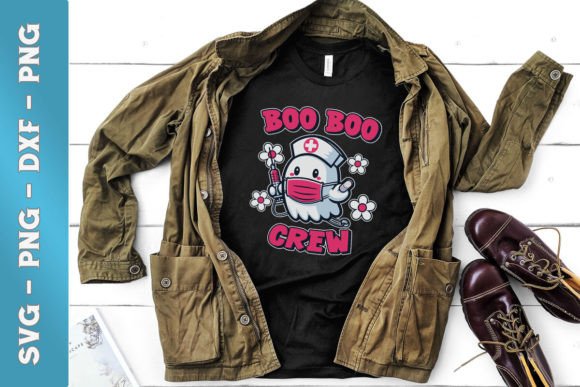
Right out of the folder, the Funny Ghost Boo Boo Crew Nurse SVG has a whimsical silhouette. The ghost isn’t trying to be scary; it’s soft, rounded, and approachable, with little nurse details that read clearly even at a glance. The “Boo Boo Crew” lettering adds a punny, heart‑forward touch that makes the design feel more like a personalized gift than a generic Halloween graphic. For an embroidery project, that’s a big deal. A design that layers humor with a clear profession nod will connect with a very specific audience: nurses, nursing students, healthcare support staff, and their families. It also lands well with anyone who loves cute Halloween decor that isn’t just skulls and ghouls.
The shape itself is well‑contained. The overall footprint is fairly compact, which I appreciate because it won’t demand a massive hoop size and can be scaled down for smaller items without losing the concept. The visual weight is balanced—the ghost sits centrally with the text wrapping around or below, and negative space is used thoughtfully. That means fewer overly dense stitch density pockets and a cleaner finish when you’re working with fill stitch or satin stitch sections. If I were to digitize this, I’d break the design into a few logical layers: the ghost body with a soft fill, the nurse cap and cross as satin accents, and the text as a controlled running stitch or light satin depending on size. That separation keeps the embroidery from turning into a stiff patch of thread.
Where the Design Really Shines in Real Embroidery Projects
I can already see this graphic working on a dozen different embroidery project types. The theme is narrow enough to be niche but broad enough to sell year after year, especially around Halloween and Nurses Week. In my mind, it’s a natural fit for custom apparel like sweatshirts and unisex t‑shirts. A left‑chest placement on a crewneck gives just enough detail to spark conversation without overwhelming the garment. On a tote bag design, as I’m planning, the ghost becomes a focal point that turns a plain canvas bag into a functional, giftable item. I’ve also tested similar designs on aprons for healthcare workers, kitchen towels for staff lounges, and even simple pillow covers for a cozy nursery or clinic waiting room.
For baby embroidery and children’s items, the cute factor is high. A tiny ghost peeking out on a baby onesie or a toddler sweatshirt feels playful and safe. Just be mindful of scale—the lettering “Boo Boo Crew” needs to remain legible, so I’d avoid shrinking the whole design below 2.5 inches wide. That’s a common threshold for small text in embroidery; anything smaller and the satin stitches can start to blur together, especially on textured fabric.
Embroidered patch projects are another strong option. The self‑contained design lends itself to a patch format with a merrowed edge or a satin‑stitch border. I’ve sold patches like this at craft fairs and on Etsy, and the nurse‑ghost combo consistently gets attention. It’s also a smart craft business product because patches are low‑risk inventory—easy to mail, fun to photograph, and they appeal to the impulse‑buy crowd. If you’re a small shop product seller, this single graphic can spin off into multiple listings: a finished tote, a patch set, a framed hoop art piece, or a digital embroidery file if you digitize it and sell the stitch file with proper licensing.
Careful Applications and When to Hold Back
No design is universal, and the Funny Ghost Boo Boo Crew Nurse SVG has a few moments where I’d pause and test before committing to a production run. The ghost’s details, especially the nurse cap cross and the facial expression, are critical for recognition. On dark fabric, those small light‑colored elements can look washed out if the thread color contrast isn’t dialed in. I always test my digitized version on a scrap of the exact fabric I’ll use, checking how the white ghost body reads against black, navy, or deep purple. Sometimes a thin outline of running stitch in a slightly darker tone around the ghost’s edges helps it pop without adding bulk.
Stretchy fabric like jersey or performance tees can also distort the text if the stabilizer isn’t right. I’d use a no‑show mesh cutaway stabilizer and baste the fabric to it before stitching. For thin fabric such as lightweight cotton tea towels, a tear‑away stabilizer usually works, but I’d still run a test to make sure the ghost’s body doesn’t tunnel. Caps and curved surfaces pose a different challenge—the design’s width might not sit perfectly on the front panel of a structured cap unless you rotate it slightly and adjust the curvature in digitizing. It’s not a dealbreaker, just a reminder that a good design still needs thoughtful placement.
I’d also avoid using this graphic on heavily textured fabrics like terry cloth or chunky knits. The small lettering and the nurse cap details will lose their crispness. If a client insists on a towel or blanket, I’d digitize a simplified version with heavier fill stitch and no tiny isolated elements. Simple is always better on looped surfaces.
From Screen to Stitch: My Practical Digitizing Checklist
When I imported the SVG into my digitizing software, the path was clean—no stray nodes, no jagged curves. That’s a big plus because messy vector files eat up hours of cleanup time. For embroidery use, I always follow a checklist that I’d recommend to anyone working with this design:
- Test on scrap fabric first. Even a perfect vector can translate into unexpected stitch behavior. I run a sew‑out on cotton, canvas, and a knit blend before showing a client or listing a product.
- Check thread color contrast. The ghost’s body, the cap, and the text each need separate thread colors that stay distinct. I pair a soft white with a cool gray shadow, a bright red or pink cross, and a dark charcoal for the lettering.
- Review stitch density. Too dense and the design feels like a board; too light and the fabric shows through. I aim for a 0.4 mm spacing on satin columns and a balanced fill that won’t perforate the fabric.
- Confirm hoop size. For a 4x4 inch hoop, the design needs to fit comfortably with at least a quarter‑inch margin. For larger placements, I scale up while keeping the text legible.
- Inspect small details. The ghost’s eyes and mouth, the cross on the cap—these are the personality points. I digitize them last and often run them as a separate color stop to adjust tension if needed.
- Test in black and white mockups. I view the design as a stitch simulation in grayscale to see if any sections blend together. This catches contrast issues early.
- Compare light and dark fabric backgrounds. I often create two color variations of the digitized file: one optimized for light fabric, one for dark.
- Use proper stabilizer. This sounds basic, but it’s the difference between a professional finish and a wavy mess. Cutaway for knits, tear‑away for woven, and always a topper for plush fabrics.
- Check licensing. The SVG listing is for a cutting file, but as a digitizer, I need to confirm whether I can legally sell the resulting embroidery file or finished products. I always read the seller’s terms and, if unclear, ask. Many digital product sellers allow small‑scale commercial use, but I never assume.
How the Design Adds Value to Handmade Products
What makes the Funny Ghost Boo Boo Crew Nurse SVG more than a cute graphic is its emotional pull. A nurse receiving a tote bag with this embroidery sees herself in it—the ghost is a little caregiver, the text is a clever inside joke. That emotional connection raises the product value instantly. Customers aren’t just buying a stitched ghost; they’re buying a moment of recognition and humor. For an Etsy seller, that means higher perceived value and a listing that can command a premium over a generic Halloween design.
From a brand consistency standpoint, the design fits neatly into a boutique line that focuses on professional appreciation gifts. If your shop already sells items for teachers, nurses, or first responders, this ghost slots right in. It’s also a great candidate for printable mockup use—you can drop the graphic into a lifestyle photo to pre‑sell a custom embroidery item before it’s even stitched. That’s a workflow I use often: I create a mockup with the design, list it, and stitch to order. The clean SVG makes the mockup look sharp, and the final embroidery finished product matches the expectation, which builds customer trust.
Giftability is another strong point. The design is specific enough to feel personal but not so narrow that it’s only relevant for one day a year. A nurse might use that embroidered tote bag all year for work supplies, and the ghost becomes a signature piece. The same goes for a holiday embroidery gift: it’s playful for Halloween, but the “Boo Boo Crew” text keeps it from being overly seasonal. That evergreen quality is important for commercial embroidery because you want inventory that doesn’t go stale on November 1st.
Final Thoughts on This Design’s Place in Your Craft Business
After working through the design’s potential, I’d confidently add it to my embroidery library. The Funny Ghost Boo Boo Crew Nurse SVG offers a clean, well‑structured graphic that digitizes into a warm, sellable machine embroidery design. It isn’t overly complex, which means faster digitizing and fewer stitch‑out failures. The theme hits a sweet spot between seasonal fun and everyday appreciation, making it versatile for a wide range of handmade products—from sweatshirt embroidery and totes to baby embroidery and patches.
For anyone running a craft business, a small shop, or an Etsy store, this design can easily become a reliable workhorse. It’s the kind of file you reach for when a customer says, “I need something cute for my nurse friend,” and you know it will stitch cleanly, look professional, and put a smile on someone’s face. That’s the quiet power of a well‑chosen graphic: it makes the whole embroidery process feel a little smoother and the final product a lot more meaningful.